
How Forestry Mulching Prevents Erosion on Your Property
Northern Kentucky has clay soil, rolling hills, and plenty of rain. Here is why forestry mulching is the best way to clear land without losing your topsoil.
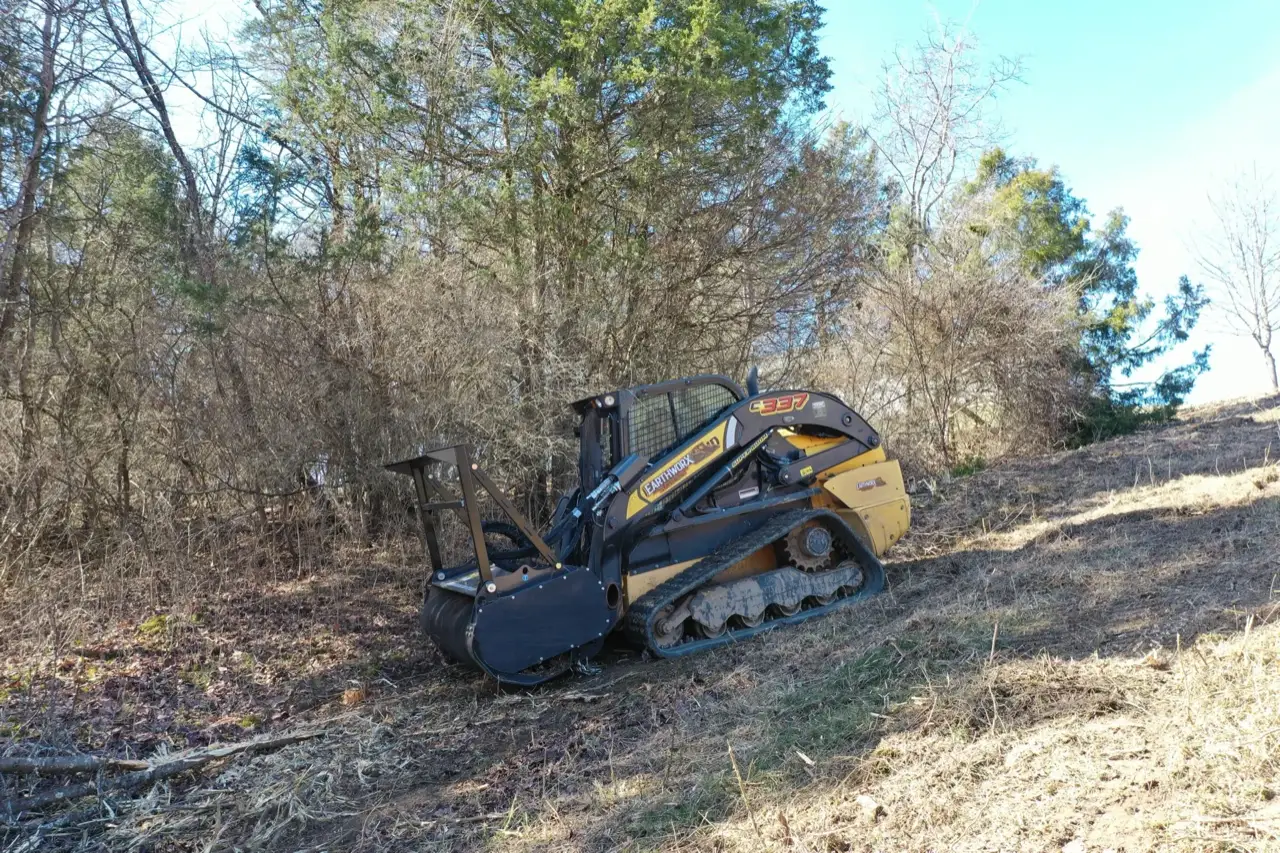
Forestry mulching prevents erosion by grinding vegetation into a 2–4 inch mulch layer that stays on the ground. This layer shields bare soil from rain impact, slows water runoff, and holds topsoil in place while new ground cover establishes. Unlike bulldozer clearing, mulching never exposes or removes the topsoil layer.
Why Erosion Is a Real Problem in Northern Kentucky
If you own property in Boone, Kenton, Campbell, or Grant County, you already know the terrain. Rolling hills, steep hollows, and clay soil that turns into a slick mess after two days of rain. The Ohio River valley carved this landscape over thousands of years, and gravity is still working on it every time a storm rolls through.
Clay soil is the main issue. Unlike sandy or loamy ground that absorbs water, the heavy clay soils throughout NKY shed water fast. When rain hits bare ground on a slope, it picks up topsoil and carries it downhill. We have seen properties near Covington and Florence where a single heavy spring rain washed 2–3 inches of topsoil off a freshly bulldozed hillside. That dirt ends up in your neighbor's yard, in the creek, or clogging a culvert under the road.
That is not theoretical. It is what happens when you clear land the wrong way on the wrong terrain.
What Happens When You Bulldoze a Hillside
Traditional land clearing with a dozer strips everything. The trees, the brush, the leaf litter, and the root network that was holding the soil together — all of it gets pushed into a pile. What's left is bare dirt. On flat ground, that might be fine for a while. On a 15-degree slope above the Licking River? You have a problem.
Here is the sequence we have seen play out dozens of times in our area:
- Dozer clears the hillside down to bare clay
- First rain event creates sheet erosion across the entire cleared area
- Water concentrates into channels, cutting rills and gullies
- Gullies deepen with each subsequent rain
- Topsoil washes to the bottom of the slope or into a waterway
- The landowner now has an erosion problem AND a clearing bill
We had a call last spring from a property owner in Pendleton County who had a contractor bulldoze about 3 acres of hillside the previous fall. By March, there were gullies 18 inches deep running across the slope. He spent more fixing the erosion damage than he did on the original clearing. That is an expensive lesson.
How Forestry Mulching Works Differently
When we mulch a property, the machine grinds standing trees, brush, and vegetation into wood chips and organic material right where it stands. Nothing gets pushed. Nothing gets piled. Nothing gets hauled away. The ground surface never sees a dozer blade.
What is left behind is a blanket of mulched material, typically 2 to 4 inches deep, sitting directly on top of the existing soil. The root systems from the cleared vegetation are still in the ground, holding the soil in place. The leaf litter and organic layer underneath the mulch is undisturbed.
That mulch layer does three things that matter for erosion:
1. It Absorbs Raindrop Impact
This sounds minor, but it is actually the first line of defense. When rain falls on bare clay soil, each drop hits like a tiny hammer. That impact breaks soil particles loose and splashes them into suspension. Soil scientists call it splash erosion, and it is the starting point for all the worse erosion that follows.
A 2–4 inch layer of wood mulch absorbs that impact completely. The raindrops hit the mulch, not the soil. The energy dissipates into the organic material. The soil underneath stays intact.
2. It Slows Surface Runoff
Even after the rain soaks through the mulch layer, it moves slower across the ground surface. The mulch acts like a rough, porous mat. Water that would sheet across bare clay at high speed instead filters through the mulch, losing velocity. Slower water carries less soil.
On the hillside properties we have cleared along the Ohio River bluffs in Campbell County, this is the difference between clean runoff and muddy runoff. Same slope, same rain, same clay soil. The mulch layer changes the equation.
3. It Holds the Soil Until New Cover Establishes
Here is the part most people do not think about: cleared land needs time to establish new ground cover. Whether you are seeding grass, planting clover, or just letting native grasses come back, there is a window of 60 to 120 days where the ground is vulnerable.
Mulch covers that window. It holds everything in place while seed germinates and roots take hold. By the time the mulch starts to decompose — which takes 6 to 18 months depending on the material — the new vegetation has already taken over the erosion protection job.
Without that mulch layer, you are racing against the weather. You have to seed immediately, hope for gentle rain, and pray you do not get a 3-inch downpour before anything sprouts. In Kentucky's spring weather? Good luck with that.
The Root Network Advantage
There is a fourth factor we do not talk about enough. When we mulch, we grind the vegetation at or just below ground level. The root systems stay in the ground. Dead roots are still roots. They still hold soil together. They still create channels for water to infiltrate.
A mature tree's root system extends 2 to 3 times the width of its canopy. Those roots are woven through the top 12–24 inches of soil. When a dozer rips a tree out, those root channels collapse and that entire volume of soil becomes loose and mobile.
When we mulch instead, the roots die and decompose slowly over 2–5 years. During that time, they are still functioning as a soil structure network. By the time they fully decompose, grass roots or new vegetation roots have replaced them. There is no gap in soil stability.
Where Erosion Control Matters Most in Our Area
Not every property has the same erosion risk. Here is where we see the biggest concerns in our service area.
Hillside Properties Above the Ohio River
From Covington through Bellevue and down to Alexandria, there are hundreds of residential properties sitting on steep clay slopes above the river. The terrain drops fast. If you are clearing overgrown brush on one of these lots, erosion control is not optional — it is the whole point of choosing the right clearing method.
Creek Banks and Drainage Areas
Properties along Woolper Creek in Boone County, Banklick Creek in Kenton County, and the Licking River corridor all have erosion-sensitive banks. Kentucky has regulations about clearing near waterways for good reason. The mulch layer from forestry mulching can help you stay in compliance while still clearing the vegetation you need removed.
Sloped Pasture and Farm Land
The rolling farmland around Williamstown, Dry Ridge, and Falmouth is not as steep as the river bluffs, but it is far from flat. We have done several pasture reclamation jobs in Grant County where the landowner wanted to clear overgrown fields and return them to grazing. On the slopes, mulching is the only method that makes sense. You cannot afford to lose the topsoil that took generations to build up.
New Construction on Graded Lots
Developers in the NKY growth corridor — Florence, Union, Hebron — are building on steeper and steeper ground as the easy flat lots get used up. We have worked with builders who mulch the lot first, keep the mulch layer in place during foundation work, and only remove it where the actual structure and driveway go. It is a smart approach that reduces erosion complaints from downhill neighbors during construction.
What Mulching Does NOT Solve
Honest take: Forestry mulching is not a magic bullet for all erosion situations. We need to be straight about the limitations.
If your slope already has active gullies — channels more than a few inches deep — mulching alone will not fix them. Gullies need to be graded and reshaped before any ground cover will hold. We can mulch the vegetation around the gully, but the gully itself needs earthwork.
If the slope is steeper than about 30 degrees and the soil is saturated clay, even mulch may not prevent all movement. Some slopes need engineered solutions — retaining walls, French drains, geotextile fabric. We will tell you if we think your site needs more than mulching.
And mulch decomposes. On south-facing slopes that get full sun, the mulch layer breaks down faster. You may need to overseed sooner than on a shaded north-facing slope. Climate and exposure matter.
Combining Mulching with Other Erosion Controls
For the best results on erosion-prone properties, we often recommend a combination approach.
- Mulch first to clear the unwanted vegetation and create the protective ground layer
- Seed within 2 weeks with a mix appropriate for your soil and sun exposure — in NKY, we like a fescue and clover blend for most applications
- Apply straw or erosion blankets on the steepest sections, anything over about 20 degrees benefits from the extra protection while seed establishes
- Install silt fence or wattles at the bottom of the slope if there is a waterway, road, or neighbor's property downhill
We can handle all of these steps. Most clients want the mulching and seeding done together, and that makes sense from a timing standpoint. The sooner seed goes down after mulching, the shorter the vulnerable window.
What This Looks Like in Practice
We cleared a 4-acre hillside property off Route 8 in Campbell County two years ago. The slope ran about 18 degrees, all clay soil, with a mix of honeysuckle, cedar, and young hackberry. The property owner wanted to clear for a view of the river and eventually plant some fruit trees.
We mulched the entire 4 acres in a day and a half. Seeded with fescue and red clover the following week. By mid-summer, the grass was 6 inches tall and the ground was stable. We went back in the fall to check, and there was zero visible erosion — no rills, no gullies, no soil migration.
Compare that to a neighboring property that had been dozer-cleared a year earlier. Same slope, same soil, same elevation. That lot still had bare patches and fresh gully cuts at the time of our visit. Two different methods, two very different outcomes, on identical terrain.
The Bottom Line on Erosion and Mulching
If you are clearing land on any kind of slope in Northern Kentucky, Southeast Indiana, or Greater Cincinnati, erosion has to be part of the conversation. Our clay soils and rolling terrain make it unavoidable.
Forestry mulching is the single best clearing method for erosion-prone sites because it never exposes the bare soil. The mulch layer buys you time, the intact root systems hold things together, and the organic material feeds the next generation of ground cover.
It is not the cheapest way to clear land in every situation. And it will not fix existing erosion damage. But for preventing new erosion during and after clearing, nothing else comes close.
If you have a hillside property you need cleared and you are worried about erosion, request a free estimate or call us at (859) 710-6107. We will come look at it and tell you what we think — including whether mulching is the right approach or if you need something else entirely.
Related Services
We Serve These Areas
How Forestry Mulching Prevents Erosion on Your Property FAQ
No. Forestry mulching is one of the least erosion-causing land clearing methods available. The 2–4 inch mulch layer left on the ground protects soil from rain impact, slows runoff, and holds topsoil in place. The root systems from cleared vegetation remain intact underground, providing additional soil stability.
Forestry mulching is far better for erosion control. Bulldozing removes all vegetation, root systems, and topsoil, leaving bare ground exposed to rain and runoff. Mulching leaves a protective layer of organic material on undisturbed soil with root systems still in place. On NKY clay hillsides, the difference is dramatic.
The mulch layer from forestry mulching typically lasts 6 to 18 months before fully decomposing, depending on sun exposure, moisture, and the type of vegetation mulched. South-facing slopes in full sun break down faster. This timeframe is usually enough for new ground cover to establish and take over erosion protection.
Yes. While the mulch layer provides immediate erosion protection, seeding within 1–2 weeks gives you long-term ground cover. A fescue and clover blend works well for most Northern Kentucky properties. On steep slopes, adding straw or erosion blankets over the seed provides extra protection while germination occurs.
Forestry mulching prevents new erosion but does not repair existing gullies or channels. Active gullies need to be graded and reshaped before ground cover will hold. We can mulch vegetation around eroded areas, but the erosion damage itself requires earthwork or engineered solutions first.
Ready to Get Started?
Free on-site estimates for all properties in our service area.
Ready to Clear Your Land?
Get a free, no-obligation estimate for your project. We respond fast and show up on time.
Try our cost calculator · Serving Northern Kentucky, Greater Cincinnati, and Southeast Indiana · 24/7 — Emergency Service Available