
Forestry Mulching in Georgetown, KY: Horse Farms, Subdivision Lots, and Bluegrass Ground
Georgetown sits where horse country runs into Toyota-driven growth, and the ground here is nothing like the clay hills up north. Bluegrass limestone soil, plank fence rows, and fast-growing pasture change how a mulching job goes.
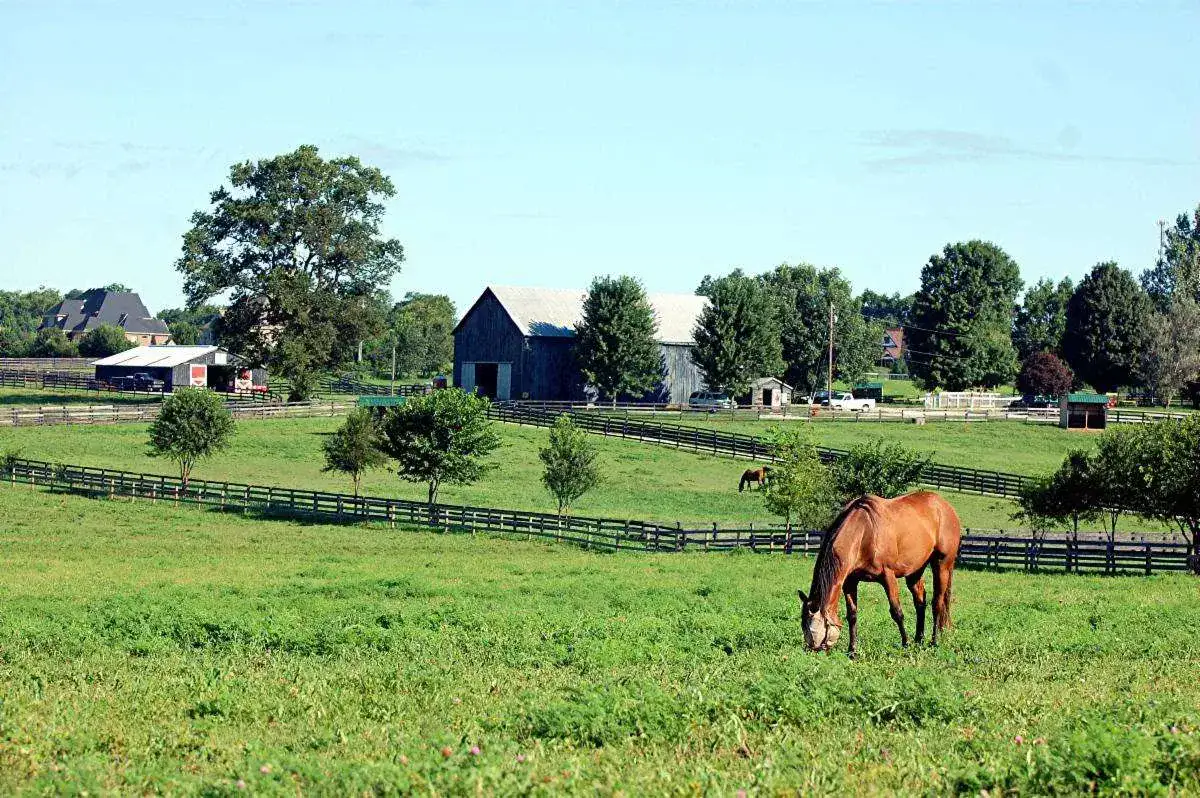
Forestry mulching in Georgetown, KY runs about $1,500 to $4,000 per acre, depending on how heavy the growth is and how the ground sits. One tracked machine grinds brush, fence-row scrub, and small trees into a chip layer right where they stand, with nothing hauled off and no burn pile. It fits Scott County well because so much of the work here is horse-farm fence lines along Iron Works Pike, wooded subdivision lots off the US-25 bypass, and Bluegrass pasture that has gone back to Osage orange and multiflora rose. Most residential lots finish in a day.
Need this handled on your property? Free on-site estimate.
What Makes Clearing in Georgetown Different?
Georgetown is our southernmost regular stop, about forty-five minutes down I-75 from our base in Demossville, and the drive tells you most of what you need to know. Plank fencing runs both sides of the highway, yearlings graze in sight of the interstate, and then the Toyota plant comes up on the right, the largest building under one roof in the state. Scott County lives in that split. Half the clearing work here is tied to the growth Toyota pulled in, and half is tied to the horse and cattle ground that was here long before the factory.
The ground itself is the other big difference. Up in Kenton and Grant counties you are working heavy clay that holds water for a week after a storm. Georgetown sits on Inner Bluegrass limestone, and the soil over it is shallower and drains better. That matters two ways. Roots on these properties spread out sideways instead of digging deep, so stumps sometimes come out cleaner. And once a lot is cleared, a builder can usually get back on it sooner because the ground firms up faster.
The catch is that the same limestone soil that built Kentucky's horse industry also grows brush fast. A pasture nobody has touched in three seasons is not overgrown, it is gone. That is the job we get called for most in Scott County.
What Is Forestry Mulching, and Why Does It Suit Scott County?
Forestry mulching uses a single tracked machine with a rotating drum of carbide teeth on the front. It grinds standing brush, vines, saplings, and trees up to about a foot across into a chip layer that stays on the ground where it fell. There is no second machine, no dump trailer, and no burn pile.
On a horse farm or a working pasture, that setup earns its keep. A conventional dozer-and-haul crew leaves you with ruts, bare dirt, and a pile of trees to burn or truck out. A mulcher leaves a mulch layer that holds the soil and slows the next round of regrowth along the fence. For a farm crew already stretched thin, that buffer buys real time between maintenance passes. We get into why the chip layer works in our guide to how forestry mulching prevents erosion.
It also keeps trucks off the property. On a subdivision lot near the US-25 bypass, hauling timber out means multiple dump-truck loads and a torn-up entrance. Mulching processes those black walnut and hackberry trees on-site and leaves the parcel graded enough for a surveyor to stake within days.
What Does Forestry Mulching Cost in Georgetown, KY?
Most Scott County work prices by the acre, because the parcels here are bigger than an in-town lot. Fence rows, pasture reclamation, and wooded building lots all fit the per-acre model. Where a job is small and awkward, like a single overgrown corner, we will quote it as a half or full day of machine time instead.
| Job type | Typical Georgetown range |
|---|---|
| Light brush and saplings, per acre | $1,500 to $2,200 |
| Medium growth with some standing timber, per acre | $2,200 to $3,000 |
| Heavy growth or difficult access, per acre | $3,000 to $4,000 |
| Fence-row clearing, per hour of machine time | $150 to $250 |
| Half day, small lot or single corner | $1,200 to $1,600 |
Three things move a Georgetown quote. The first is what is actually growing there, because a stand of honey locust with two-inch thorns grinds slower than soft brush. The second is standing timber, since the more mature trees you want left in place, the more careful the operator has to be around them. The third is walnut. Black walnut stumps are notoriously hard to grind, and if you want them gone rather than mulched flush, that is a separate pass with the stump grinding attachment. For the wider regional picture, our forestry mulching cost breakdown covers the whole tri-state.
Bill’s honest take: I will not quote a Georgetown pasture off a phone call. Half the time the aerial photo shows a solid green mess and it is really just tall grass with a few cedars, and the price comes way down once I walk it. The other half there is an old woven-wire fence buried in the brush that nobody remembered, and I would a lot rather find that before the machine does than after. On horse ground especially, I want to see the fence line myself.
Which Georgetown Properties Need Clearing Most?
Horse-Farm Fence Rows
This is the everyday Scott County call. Fence rows along Iron Works Pike, Cane Ridge Road, and Newtown Pike get overtaken by Osage orange, multiflora rose, and honey locust volunteers, and all three will crack a plank board or push a post out of line. A mulcher clears the growth flush to the fence without touching the boards, and leaves a mulch strip that keeps it from coming back as fast. We handle a lot of this through our fence line clearing work, and our guide to fence row clearing on Kentucky farms goes deeper on it.
Wooded Subdivision Lots
Residential growth in Georgetown clusters east of the US-25 bypass and along US-62 toward I-75. A lot of these lots come wooded, with mature black walnut, ash, and hackberry that would take several truckloads to haul out by hand. The mulcher processes trees up to about twelve inches on-site and leaves the lot walkable and ready for a survey. If you are building, our post on land clearing for new home construction walks through the sequence.
Overgrown Bluegrass Pasture
Neglected pasture reverts fast on this soil. Three growing seasons is enough to turn grazing ground into head-high brush studded with cedar and locust. Reclaiming it by hand is a miserable job; a mulcher grinds the whole field back to usable ground in a fraction of the time and leaves the chips to feed the soil. Our pasture reclamation service and the pasture reclamation guide cover how we bring a field back.
Elkhorn Creek Storm Damage
Elkhorn Creek winds through Scott County, and the bottoms along it flood and take storm damage most years. Spring high water drops debris fields on the banks, and Kentucky's storm season topples weakened sycamores and river birch into pastures and yards. We clean up along the corridor but stay careful near the bank, mulching downed canopy without ripping out the root systems that hold the soil together. More on that in our storm damage cleanup guide.
What Grows on Scott County Land?
The cast is a little different here than up north, where honeysuckle runs everything.
- Osage orange (hedge apple) shows up in old field-boundary rows planted generations ago. It is dense, thorny, and hard on equipment, and it is one of the more common fence-line problems in Scott County.
- Multiflora rose forms thorny thickets across pasture and fence lines, and it spreads through the whole field if it is left. Our multiflora rose removal guide covers the follow-through.
- Honey locust volunteers come up along fences with thorns long enough to flatten a tractor tire, which is a real reason not to fight them with a brush hog.
- Bush honeysuckle is here too, mostly on the shaded edges and in town, though it is not the wall-to-wall problem it is closer to the river.
- Volunteer cedar, walnut, and locust fill any gap in a pasture within a season or two.
A mulcher grinds the top growth on all of these in one pass. For the aggressive spreaders like multiflora rose and honey locust, plan on mulching as the first step rather than the last, with a follow-up the next season either as a light second pass or targeted treatment. Our invasive species removal page covers that part.
Do You Need a Permit to Clear Land in Georgetown?
For a single residential lot or a fence row on your own farm, generally no. Grinding brush and small growth on your own ground is not the kind of work that trips a permit.
Two things change that. If your project disturbs one acre or more of soil, Kentucky requires coverage under the KYR10 stormwater general permit along with an erosion control plan. And if your property sits in the Elkhorn Creek floodplain, Scott County has setback and buffer rules near the creek, which is exactly why we mulch above the root zone along the bank rather than scraping it. Anything involving grading or a change to how water leaves the property is worth a call to the county before you start. Our post on Kentucky land clearing permits walks through the acre threshold in detail.
When Is the Best Time to Mulch in Georgetown?
Late fall through early spring is ideal, for the usual reasons. The leaves are down, so the operator can see the fence, the ground, and whatever is hiding in the brush. Growth is bare and grinds faster. And the ground is firm, which keeps the machine from marking up a pasture you want to graze again in a few months.
Bluegrass soil drains better than the clay up north, so summer work here is more forgiving than it is in Kenton County. Even so, we stay off the Elkhorn bottoms right after heavy rain. The creek-bottom clay holds water longer than the upland ground, and a machine on saturated ground makes ruts that outlast the job.
How Long Does a Georgetown Job Take?
- Fence row, half-mile stretch: a few hours to a half day.
- Average wooded subdivision lot: one day.
- Overgrown pasture, one to three acres: one to two days depending on how heavy the growth is.
- Storm cleanup along a creek bottom: a half day to a day, depending on the debris.
- Larger reclamation project, several acres: two days or more.
Most residential and single-field jobs in Scott County wrap in a day. The longer timelines come from acreage and heavy standing timber, not from the ground being difficult to work.
Getting a Quote in Georgetown
We run Georgetown regularly along with the rest of Scott County, and the drive down through Grant County means we are often already headed that way. Lexington and Georgetown mark the southern edge of our standard area, and we build the travel into the estimate, so there is no surprise mobilization fee.
Send us the address and what you are trying to accomplish, whether that is a fence row, a building lot, or a pasture you want back. We will come look at it, tell you whether mulching is the right tool, and give you a real number. Sometimes it is not the right tool, and we will say so. If you want to check the questions to ask any contractor first, our guide to choosing a land clearing company lays them out.
We Serve These Areas
Related Articles
Forestry Mulching vs. Traditional Land Clearing: Which Is Better for Your Property?
A head-to-head comparison of forestry mulching and traditional land clearing. We break down cost, speed, soil impact, and which method wins for different property types.
8 min read readForestry Mulching vs. Bulldozing: Cost, Speed, and Results Compared
A direct comparison of forestry mulching and bulldozing for land clearing. Costs, timelines, soil damage, and honest advice on which method fits your project.
7 min read readForestry Mulching vs. Brush Hogging: When to Use Each Method
Brush hogging and forestry mulching handle different problems. Here is when each method makes sense, what they cost, and where one clearly beats the other.
6 min read readForestry Mulching in Georgetown, KY: Horse Farms, Subdivision Lots, and Bluegrass Ground FAQ
Most Scott County work prices by the acre: roughly $1,500 to $2,200 per acre for light brush, $2,200 to $3,000 for medium growth with some standing timber, and $3,000 to $4,000 for heavy growth or difficult access. Fence-row clearing often runs by machine time at $150 to $250 per hour, and a small single-corner job is usually a $1,200 to $1,600 half day. Standing timber you want left in place and hard-to-grind walnut stumps push the number up.
Regularly. Fence rows along Iron Works Pike, Cane Ridge Road, and Newtown Pike are some of our most frequent Georgetown jobs. A mulcher clears Osage orange, multiflora rose, and honey locust flush to the plank fence without damaging the boards or posts, and leaves a mulch buffer that slows regrowth.
Yes. We mulch downed canopy and overgrowth above the root zone and preserve the understory and root systems that stabilize the bank. For properties in the Elkhorn floodplain we also follow Scott County setback and buffer rules, so ask us about your specific parcel.
A single residential lot or a fence row on your own farm generally does not require one. If your project disturbs one acre or more of soil, Kentucky requires KYR10 stormwater permit coverage and an erosion control plan. Property in the Elkhorn Creek floodplain also has county setback rules near the water, so check with Scott County if that applies to you.
Scott County soils are shallower over limestone than the clay soils further north, so roots spread wider than they dig deep and stumps sometimes pull cleaner. Drainage is better too, which means a cleared lot firms up faster and a builder can usually get back on it sooner. The trade-off is that the same rich soil grows brush back quickly, so pasture and fence rows need attention on a shorter cycle.
Georgetown and Lexington mark the southern edge of our standard service area, about forty-five minutes from our Demossville base. We include travel in the estimate, so there is no separate mobilization fee for coming down to Scott County.
Ready to Get Started?
Free on-site estimates for all properties in our service area.
Ready to Clear Your Land?
Get a free, no-obligation estimate for your project. We respond fast and show up on time.
Try our cost calculator · Serving Northern Kentucky, Greater Cincinnati, and Southeast Indiana · 24/7 — Emergency Service Available